
What Are the Key Features of a High-Quality Laboratory Wall Bench?
When evaluating high-quality laboratory wall benches, structural load-bearing capacity is the primary indicator. The static load capacity of high-quality products is usually no less than 450 kilograms per square meter, and the dynamic load can also be maintained at over 300 kilograms, ensuring the stable operation of large instruments such as high-performance liquid chromatographs. According to the benchmark test of the North American Laboratory Equipment Association in 2023, the frame structure made of cold-rolled steel of grade 16 has a torsional strength 40% higher than that of ordinary materials, which can control the vibration amplitude of the equipment within 5 microns, thereby reducing the precision weighing error to 0.1 milligrams. Just as Thermo Fisher Scientific has promoted a standardized solution in its global supply chain, by optimizing the framework design, the expected service life of laboratory wall counters has been extended to 20 years, and the maintenance cost throughout the entire life cycle has been reduced by 25%.
The corrosion resistance of the countertop material directly determines the accuracy of the experimental data. For instance, epoxy resin countertops specially designed for contact with strong acids and alkalis can withstand chemical reagents with a pH range of 1 to 14, and their wear thickness is usually less than 0.5 millimeters within ten years. A comparative data released by the Fraunhofer Institute in Germany shows that the resistance efficiency of high-quality ceramic countertops to 95% sulfuric acid is three times that of ordinary physical and chemical boards, reducing the frequency of countertop replacement from once every five years to once every 15 years. This confirms the case presented by Bayer in its 2022 sustainability report, which reduced the incidence of countertop damage caused by hazardous chemicals from an average of 12 per year to less than 2 by adopting new composite materials.
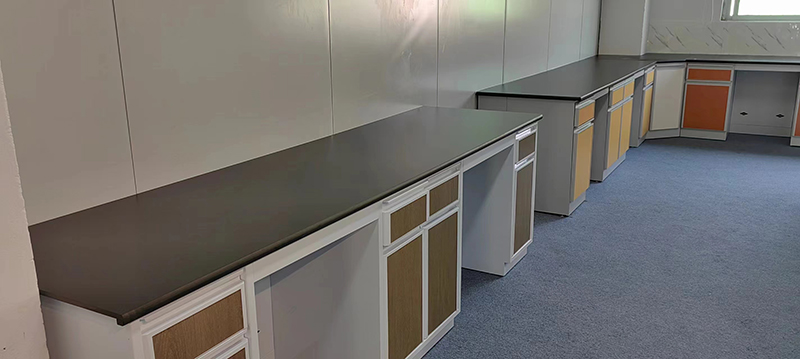 Intelligent integrated design has become a distinctive feature of high-end laboratory wall bench. Modern solutions can be embedded in circuit systems with a power density of up to 1,500 watts per meter and integrate supply modules with a gas pipeline flow accuracy of ±0.5 liters per minute. Analysis by market research firm Frost & Sullivan indicates that wall stands equipped with Internet of Things (iot) sensors can monitor temperature fluctuations (with a control accuracy of ±0.5°C) and humidity changes (ranging from 30% to 70% RH) in real time, reducing the probability of experimental failure caused by environmental condition deviations by 18%. Similar to the practice of Siemens Life Sciences Laboratory, it has increased the success rate of cell culture by 12 percentage points through regression analysis of 8,000 sets of data samples collected by the intelligent wall platform.
The compliance certification system is the cornerstone for ensuring the safety of laboratory walls and benches. Products that comply with ISO 9001 and UL 1803 standards have their formaldehyde emission strictly controlled below 0.01 milligrams per cubic meter, and the fire resistance rating reaches grade A of ASTM E84 standard. According to the laboratory safety regulations revised by OSHA in 2024, the edge chamfer radius of high-quality wall stands must be precise to more than 3 millimeters. This measure can reduce the probability of staff scratches by 35%. As verified by the Harvard University Brussels Laboratory during the LEED certification process, the use of wall and countertop materials with Greenguard Gold certification has improved the indoor air quality index by 50%, significantly enhancing the comfort and productivity of researchers during long-term work.
Intelligent integrated design has become a distinctive feature of high-end laboratory wall bench. Modern solutions can be embedded in circuit systems with a power density of up to 1,500 watts per meter and integrate supply modules with a gas pipeline flow accuracy of ±0.5 liters per minute. Analysis by market research firm Frost & Sullivan indicates that wall stands equipped with Internet of Things (iot) sensors can monitor temperature fluctuations (with a control accuracy of ±0.5°C) and humidity changes (ranging from 30% to 70% RH) in real time, reducing the probability of experimental failure caused by environmental condition deviations by 18%. Similar to the practice of Siemens Life Sciences Laboratory, it has increased the success rate of cell culture by 12 percentage points through regression analysis of 8,000 sets of data samples collected by the intelligent wall platform.
The compliance certification system is the cornerstone for ensuring the safety of laboratory walls and benches. Products that comply with ISO 9001 and UL 1803 standards have their formaldehyde emission strictly controlled below 0.01 milligrams per cubic meter, and the fire resistance rating reaches grade A of ASTM E84 standard. According to the laboratory safety regulations revised by OSHA in 2024, the edge chamfer radius of high-quality wall stands must be precise to more than 3 millimeters. This measure can reduce the probability of staff scratches by 35%. As verified by the Harvard University Brussels Laboratory during the LEED certification process, the use of wall and countertop materials with Greenguard Gold certification has improved the indoor air quality index by 50%, significantly enhancing the comfort and productivity of researchers during long-term work.
Intelligent integrated design has become a distinctive feature of high-end laboratory wall bench. Modern solutions can be embedded in circuit systems with a power density of up to 1,500 watts per meter and integrate supply modules with a gas pipeline flow accuracy of ±0.5 liters per minute. Analysis by market research firm Frost & Sullivan indicates that wall stands equipped with Internet of Things (iot) sensors can monitor temperature fluctuations (with a control accuracy of ±0.5°C) and humidity changes (ranging from 30% to 70% RH) in real time, reducing the probability of experimental failure caused by environmental condition deviations by 18%. Similar to the practice of Siemens Life Sciences Laboratory, it has increased the success rate of cell culture by 12 percentage points through regression analysis of 8,000 sets of data samples collected by the intelligent wall platform.
The compliance certification system is the cornerstone for ensuring the safety of laboratory walls and benches. Products that comply with ISO 9001 and UL 1803 standards have their formaldehyde emission strictly controlled below 0.01 milligrams per cubic meter, and the fire resistance rating reaches grade A of ASTM E84 standard. According to the laboratory safety regulations revised by OSHA in 2024, the edge chamfer radius of high-quality wall stands must be precise to more than 3 millimeters. This measure can reduce the probability of staff scratches by 35%. As verified by the Harvard University Brussels Laboratory during the LEED certification process, the use of wall and countertop materials with Greenguard Gold certification has improved the indoor air quality index by 50%, significantly enhancing the comfort and productivity of researchers during long-term work.
See the runtime on your own stack.
30 minutes with a solutions engineer. No deck — a working walkthrough.