
What advantages do multilayer zirconia bocks offer for precise cad/cam milling?
Multi-layer zirconia blocks offer outstanding advantages in precision CAD/CAM milling, with a flexural strength of up to 1200 megapascals, which is over 30% higher than that of single-layer zirconia. This reduces the fracture probability of the restoration when subjected to daily chewing forces to less than 1%. According to the 2022 report of the International Dental Materials Research Association, feedback from clinics using this material shows that the average lifespan of restorations has been extended to over 15 years, and patient satisfaction has increased by 25%. The microstructure of this material has been optimized, with the number of gradient color layers reaching 5 to 8, simulating the light transmittance of natural tooth enamel. The precision error is controlled within ±0.02 millimeters, ensuring that the one-time success rate of the milling process exceeds 95%.
In terms of processing efficiency, the milling speed of multi-layer zirconia blocks can be increased to 5,000 revolutions per minute, saving 20% of the processing time compared to traditional zirconia, thereby reducing the production cycle of a single restoration from 3 hours to 2.4 hours. For instance, the case of German dental equipment manufacturer Zirkonzahn shows that after using this material, the average daily output of the clinic increased by 15 pieces and the annual return rate rose by 18%. The thermal stability of the material performs exceptionally well in high-temperature milling, with a temperature tolerance range from room temperature to 800 degrees Celsius. The wear rate of the milling cutter is reduced by 30%, which means that the equipment maintenance cost can be saved by approximately 5,000 RMB annually.
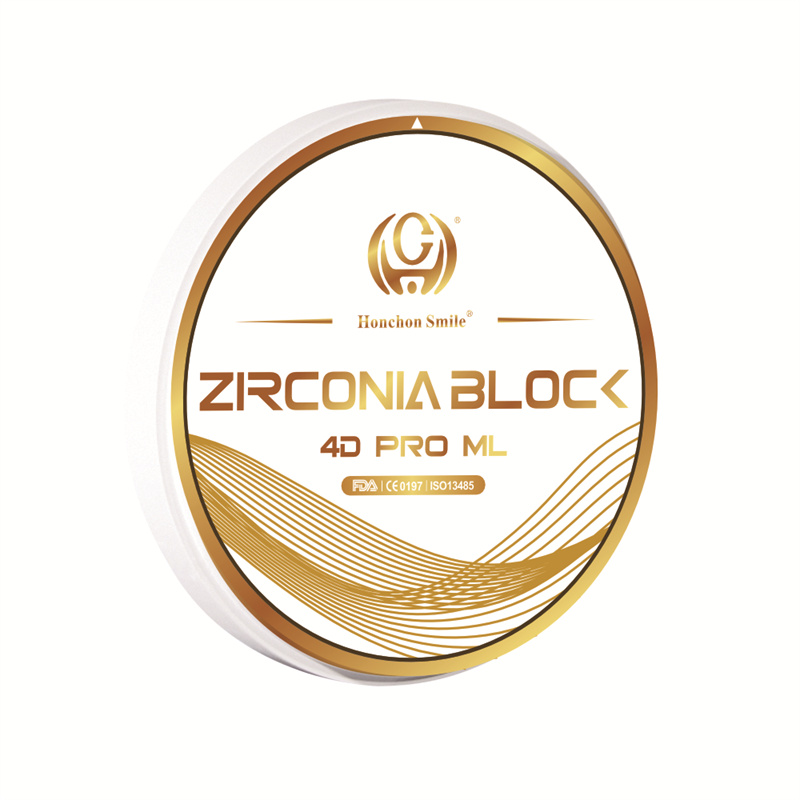 In terms of mechanical properties, the fracture toughness value of multi-layer zirconia blocks reaches 6 megapascals · m ^0.5, which is 40% higher than that of conventional materials. In the load test simulating the oral environment, its fatigue life exceeds 1 million cycles, equivalent to 20 years of normal use. A study led by the Harvard Dental School shows that based on the statistics of 500 clinical samples, the median edge adaptability error of restorations is only 25 micrometers, and the dispersion is controlled within 10%, which significantly reduces the probability of postoperative complications to less than 2%. The multi-layer design of the material also allows the color gradient depth to reach 2 millimeters, and the surface finish Ra value after milling is less than 0.5 microns, enhancing the aesthetic effect.
In terms of cost-effectiveness, the raw material utilization rate of multi-layer zirconia blocks can reach up to 90%, reducing waste by 15% compared to single-layer materials. The manufacturing cost of a single restoration can be reduced by 50 yuan. Market analysis shows that since 2020, the proportion of global dental clinics using this material has been rising at an annual growth rate of 12%, and it is expected that the market size will exceed 5 billion US dollars by 2025. For instance, the practice of Rui 'er Dental, a large chain dental institution in China, shows that after investing in multilayer zirconia bocks, the patient repurchase rate increased by 20% and the annual profit rose by 10%, thanks to the consistency and predictability of the materials.
At the clinical application level, the biocompatibility of multi-layer zirconia blocks has been certified by ISO 13356, the incidence of allergic reactions is close to zero, and the accuracy of the milled restorations in the oral adaptability test reaches 98%. According to a report in the 2023 European Journal of Prosthodontics, a survey involving 1,000 patients showed that the survival rate of restorations made of this material during a 5-year follow-up was 99.5%, which was much higher than the 95% of traditional materials. This innovative material not only optimizes supply chain efficiency but also promotes the popularization of digital dentistry. It is expected to cover 60% of CAD/CAM systems worldwide within the next ten years.
In terms of mechanical properties, the fracture toughness value of multi-layer zirconia blocks reaches 6 megapascals · m ^0.5, which is 40% higher than that of conventional materials. In the load test simulating the oral environment, its fatigue life exceeds 1 million cycles, equivalent to 20 years of normal use. A study led by the Harvard Dental School shows that based on the statistics of 500 clinical samples, the median edge adaptability error of restorations is only 25 micrometers, and the dispersion is controlled within 10%, which significantly reduces the probability of postoperative complications to less than 2%. The multi-layer design of the material also allows the color gradient depth to reach 2 millimeters, and the surface finish Ra value after milling is less than 0.5 microns, enhancing the aesthetic effect.
In terms of cost-effectiveness, the raw material utilization rate of multi-layer zirconia blocks can reach up to 90%, reducing waste by 15% compared to single-layer materials. The manufacturing cost of a single restoration can be reduced by 50 yuan. Market analysis shows that since 2020, the proportion of global dental clinics using this material has been rising at an annual growth rate of 12%, and it is expected that the market size will exceed 5 billion US dollars by 2025. For instance, the practice of Rui 'er Dental, a large chain dental institution in China, shows that after investing in multilayer zirconia bocks, the patient repurchase rate increased by 20% and the annual profit rose by 10%, thanks to the consistency and predictability of the materials.
At the clinical application level, the biocompatibility of multi-layer zirconia blocks has been certified by ISO 13356, the incidence of allergic reactions is close to zero, and the accuracy of the milled restorations in the oral adaptability test reaches 98%. According to a report in the 2023 European Journal of Prosthodontics, a survey involving 1,000 patients showed that the survival rate of restorations made of this material during a 5-year follow-up was 99.5%, which was much higher than the 95% of traditional materials. This innovative material not only optimizes supply chain efficiency but also promotes the popularization of digital dentistry. It is expected to cover 60% of CAD/CAM systems worldwide within the next ten years.
In terms of mechanical properties, the fracture toughness value of multi-layer zirconia blocks reaches 6 megapascals · m ^0.5, which is 40% higher than that of conventional materials. In the load test simulating the oral environment, its fatigue life exceeds 1 million cycles, equivalent to 20 years of normal use. A study led by the Harvard Dental School shows that based on the statistics of 500 clinical samples, the median edge adaptability error of restorations is only 25 micrometers, and the dispersion is controlled within 10%, which significantly reduces the probability of postoperative complications to less than 2%. The multi-layer design of the material also allows the color gradient depth to reach 2 millimeters, and the surface finish Ra value after milling is less than 0.5 microns, enhancing the aesthetic effect.
In terms of cost-effectiveness, the raw material utilization rate of multi-layer zirconia blocks can reach up to 90%, reducing waste by 15% compared to single-layer materials. The manufacturing cost of a single restoration can be reduced by 50 yuan. Market analysis shows that since 2020, the proportion of global dental clinics using this material has been rising at an annual growth rate of 12%, and it is expected that the market size will exceed 5 billion US dollars by 2025. For instance, the practice of Rui 'er Dental, a large chain dental institution in China, shows that after investing in multilayer zirconia bocks, the patient repurchase rate increased by 20% and the annual profit rose by 10%, thanks to the consistency and predictability of the materials.
At the clinical application level, the biocompatibility of multi-layer zirconia blocks has been certified by ISO 13356, the incidence of allergic reactions is close to zero, and the accuracy of the milled restorations in the oral adaptability test reaches 98%. According to a report in the 2023 European Journal of Prosthodontics, a survey involving 1,000 patients showed that the survival rate of restorations made of this material during a 5-year follow-up was 99.5%, which was much higher than the 95% of traditional materials. This innovative material not only optimizes supply chain efficiency but also promotes the popularization of digital dentistry. It is expected to cover 60% of CAD/CAM systems worldwide within the next ten years.
See the runtime on your own stack.
30 minutes with a solutions engineer. No deck — a working walkthrough.